first time mom?check my new blog!

Your Guide to Obtaining a Japanese Language Certificate: Tips for Success
This blog gives a brief information on the types of Japanese Language Test and how you can pass the examination.
クリス
2/2/20254 min read


Introduction to Japanese Language Certificates
In an increasingly globalized world, proficiency in Japanese can open doors to various opportunities, whether for academic pursuits, career advancements, or personal growth. Obtaining a Japanese language certificate not only validates your skills but also enhances your credibility. This blog will outline the types of Japanese language certificates available and provide effective strategies to pass your exams with confidence.
Types of Japanese Language Certificates
The Japanese-Language Proficiency Test (JLPT) is the most recognized certification for non-native speakers. It consists of five levels, with N1 being the highest and N5 the most basic. Many institutions and employers regard N2 and N1 certificates as essential for advanced language proficiency. In addition to the JLPT, there are other certifications available, such as the J-Test and J-NAT which test different aspects of language ability.
If you are planning to get a Japanese Language Certificate you need to consider which of those 3 mentioned above you would like to take.
J-NAT vs JLPT
Similarities
Both exams use the same question types and formats
Both exams have five levels, with similar difficulty levels
The NAT-TEST is based on the JLPT and can be used to prepare for it.
Differences
The JLPT is held twice a year, while the NAT-TEST is held six times a year in some Asian cities
The JLPT is more widely recognized and considered to be the standard for Japanese proficiency by many companies
The passing score on JLPT and Japanese Language NAT-Test (J-NAT) depends on the level you are taking, but generally, the total score needs to be at or above the point required for passing (overall pass mark) and score in each scoring section needs to be at or above the minimum point required for passing (sectional pass mark).If there is even one section where the score is below the sectional pass mark, examinees are determined to have failed, no matter how high the total score he/she might have.
J-TEST vs JLPT
1. J.TEST is divided into three levels, allowing you to take the test according to your level..
A-C Level (For advanced learners; equivalent to N2/N1)
D-E Level (For intermediate learners; equivalent to N4/N3)
F-G Level (For beginners; equivalent to N5)
The full mark for A-C level in J.TEST is 1000 points, and for D-E level, it's 700 points. More than 350 points in D-E level is equivalent to N4, and more than 500 points is N3 level. Thus, the results vary based on the score. Also, if someone who passed N1 scores over 800 points in A-C level, it proves they have a level higher than N1.
JLPT is held twice a year in July and December (once a year in some countries outside Japan), but J.TEST same with J-NAT can be taken six times a year. Therefore, it can also be taken for practice before attempting JLPT.
2. J.TEST has a higher score for listening comprehension than JLPT and is recommended for those good at Listening Comprehension but not advisable for those who is weak in grammar. Unlike JLPT, J.Test has a section where in you need to complete the sentences by filling in the blank. I remember back then when I first took my J.Test, I only got the N5 level because I failed to get a score on the last section which is fill in the blank. I admit my grammar back then was very weak I just studied for only 3 months back then when I took the test.
Strategies to Pass the Certification Exam
Preparing for a Japanese language certification exam can be challenging, but with the right approach, success is achievable. Here are some tips to guide you:
Understand the Exam Format: Familiarize yourself with the structure and content of the exam you wish to take. The JLPT, for instance, includes sections on reading, listening, and language knowledge.
Create a Study Schedule: Consistency is key. Develop a study plan that allocates time for each subject area. This will help you manage your preparation and ensure balanced coverage of all topics.
Use Authentic Materials: Engage with materials that reflect actual language usage. Japanese books, newspapers, and media can strengthen your comprehension and vocabulary.
Practice with Past Papers: Completing practice exams or past papers can provide insight into the types of questions asked and help identify areas for improvement.
Join a Study Group: Collaborating with peers can enhance your learning experience. Study groups provide motivation, allow for shared resources, and facilitate conversational practice.
Take Professional Classes: If possible, consider enrolling in a formal language course. Qualified instructors can provide expertise and guidance tailored to your needs.
Lastly, maintain a positive attitude throughout your preparation. Language acquisition takes time and effort, but nurturing a growth mindset will keep you motivated.
Conclusion
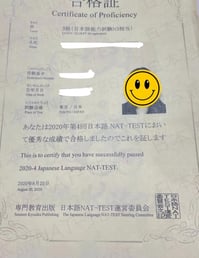
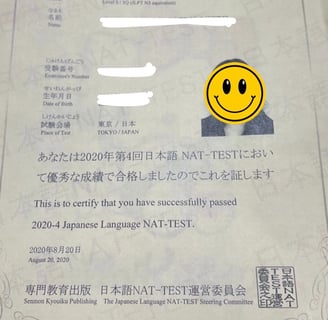
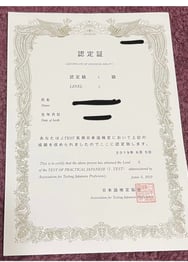
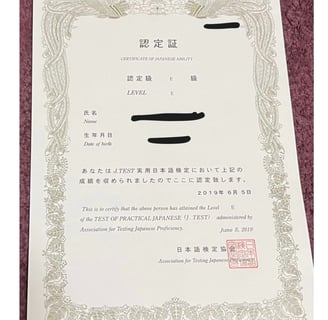
Learning the language is a journey so you must not force yourself to learn everything in a short period of time. Take one step at a time. Do your own research and study well. Don't be sad if you fail on your first take that is where you can learn if you will be able to experience the actual exam. JLPT is said to be the most recognizable but don't just focus on one. I, personally failed to get N4 on my first take of J. TEST but was able to get N5. Then first take of JLPT I also failed but was able to get my N4 certificate on my second take of J.TEST. Then, I got my N3 level when I first took J-NAT here in Japan back in 2020.Don't be afraid to fail, if you plan on giving up, then you should be afraid.
Obtaining a Japanese language certificate can significantly impact your language mastery and future prospects. By understanding the certification options and implementing effective study strategies, you can enhance your chances of success. Remember the value of practice, persistence, and resourcefulness as you embark on this rewarding journey in mastering the Japanese language. Good luck in your pursuit of certification!
Discover daily life and wellness in Japan.
© 2025. All rights reserved.


Subscribe now!